Integrating Wearable Sensors into Physiotherapy Assessment: Validity and Clinical Utility
DOI:
https://doi.org/10.64474/3107-6343.Vol2.Issue1.2Keywords:
- Wearable Sensors, Physiotherapy Assessment, Human Clinical Study, Musculoskeletal Dysfunction, Gait Analysis, Functional Recovery, Rehabilitation Monitoring
Abstract
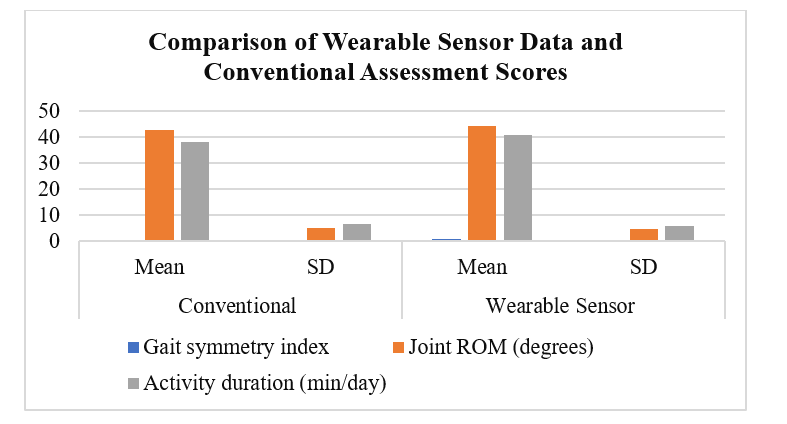
Wearable sensor devices have been suggested to become a promising instrument of improving objectivity and accuracy in the assessment of physiotherapy but its validation has been demonstrated mainly in case of human research. The validity and clinical utility of wearable sensor-based physiotherapy assessment were evaluated in a controlled human clinical study of musculoskeletal dysfunction. Adult human participants with clinically diagnosed musculoskeletal impairment received conventional physiotherapy interventions, under which wearable inertial sensors were recorded to measure gait symmetry, range of motion in joints, and activity levels. Measurement of sensors was compared with traditional observational and biomechanical measurement tools on a four-week intervention time. The findings show that there was a strong and statistically significant correlation between wearable sensor outputs and conventional assessment measures and a high sensitivity of the wearable sensor to identify the time-dependent functional recovery. It was found that gradually, during the intervention period, functional parameters improved, and the wearable sensor-integrated group had better recovery results than either standard evaluation and control groups. Such results prove the validity and clinical relevance of wearable sensors in objective evaluation of physiotherapy and show the need to provide clinical validation to facilitate their use in the context of rehabilitation.