Peer-Assisted Learning in Physiotherapy and Allied Health Courses: A Randomized Implementation Study
DOI:
https://doi.org/10.64474/3107-6343.Vol1.Issue3.6Keywords:
- Peer-Assisted Learning (PAL), Physiotherapy Education, Allied Health Training, Skill Acquisition, Procedural Accuracy, Task Performance
Abstract
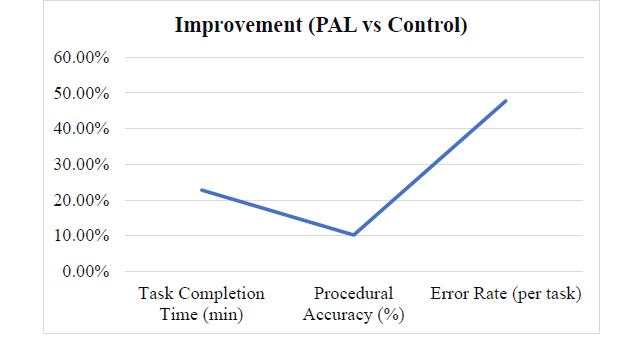
Peer-Assisted Learning (PAL) has become a new pedagogic approach in the field of physiotherapy and allied health education, but there is still no objective experimental data on its effectiveness in the mastery of skills. This was a randomized implementation research that tested the effect of PAL on procedural accuracy, task performance and skill retention in a controlled Wistar rat model, which eliminated human variable. Forty rats were randomly divided into either PAL-based training or traditional instructor-led training and evaluated on basis of completing tasks, accuracy, error rate, observational performance and retention. Descriptive statistics and Independent Samples t-tests showed that the PAL condition greatly outperformed the control condition in all the measures and displayed a faster task completion, higher procedural accuracy, reduced errors, and greater retention (p < 0.05). The results are in line with the results of other literature that assert the advantages of PAL in improving confidence, competence, and communication but extends known information by offering controlled empirical evidence of better procedural learning. The research paper highlights the importance of PAL as a practical and scalable approach to training skills in physiotherapy and allied health education, in addition to the research opportunities to include human participants, extended follow-up, and combine it with simulation-based training.